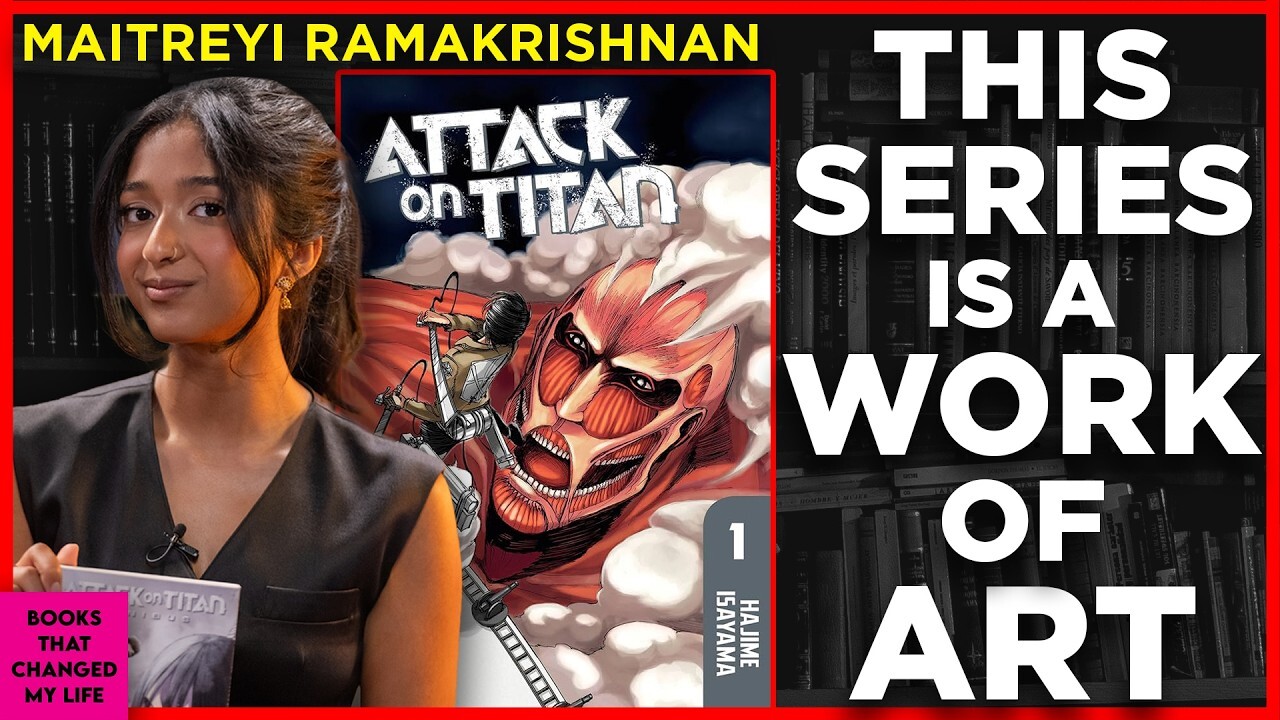
Maitreyi Ramakrishnan Explains Why Attack on Titan Feels Political
 0
0
 0
0 Direct Answer
Maitreyi Ramakrishnan sees Attack on Titan as far more than animated spectacle because Hajime Isayama’s story reveals how fear, state propaganda, and inherited trauma can manipulate entire communities. Beyond its action sequences, the series functions as a cautionary tale about how societies construct narratives to justify cruelty, strip away individual empathy, and perpetuate cycles of violence.
📺 Prefer watching over reading? You can stream full, uncut video conversations on the Books That Changed My Life YouTube Channel.
Key Takeaways
Beyond the Action: The series uses its dark fantasy setting to highlight real-world mechanisms of power, fear, and social control.
Deconstructing Propaganda: State narratives often convince populations to view neighbors as existential threats without questioning the source.
Fandom Meets Empathy: Ramakrishnan’s connection to the series shows how pop culture can spark meaningful conversations about real-world ethics and activism.
An Activist’s Upbringing: Raised by Sri Lankan Tamil genocide survivors, Ramakrishnan was taught from a young age to analyze power dynamics critically.
About the Guest
Maitreyi Ramakrishnan is a Canadian actress. She starred in Netflix’s comedy series Never Have I Ever. Raised in Mississauga, Ontario, her parents survived the Tamil genocide in Sri Lanka. Today, she advocates for social justice, worker rights, and media representation.
About the Book
Attack on Titan (Shingeki no Kyojin) is a manga series created by Hajime Isayama. The story begins as humans hide behind massive walls to survive man-eating Titans. However, childhood friends Eren, Mikasa, and Armin soon discover the outside world. The plot quickly transforms into a story about war, state propaganda, and generational conflict.
How Fandom Connects to Real-World Empathy
Ramakrishnan learned to view media critically at a young age. Her parents were union representatives who spoke openly about politics. Consequently, she attended her first protest at age five. By middle school, she organized student walkouts and debated news articles over dinner.
When she read Attack on Titan in her school library, the story made an immediate impression:
“It is about how humanity has the constant desire to oppress, to conquer, and take over people. It is a vicious cycle that we cannot get out of.” — Maitreyi Ramakrishnan
As a thirteen-year-old, she initially saw the story as a straightforward battle between humans and monsters. But as the world outside the walls was exposed, she watched every faction turn out to be driven by past trauma, political lies, and fear. The series taught her that real-world conflicts expand when people refuse to question the stories they inherit.
Audition Traditions, Sasha Braus, and Active Change
Her relationship with the show is also full of personal nostalgia. Back in middle school, the very first piece of clothing she bought with her own money was an Attack on Titan sweater from Hot Topic. It is an item she still brings to acting auditions today as a lucky charm. She also loved Sasha Braus (“Potato Girl”) for her humor, big appetite, and total lack of enthusiasm during military drills.
To Ramakrishnan, the ultimate value of Attack on Titan lies in how it challenges viewers to drop moral arrogance. Stopping real-world harm starts by dismantling personal ignorance, questioning authority, and actively listening to the lived experiences of others.
Structured Frameworks for Growth
If you want to handle tough conversations, build better relationships, and grow as a leader, clear guidance makes all the difference. The I AM LEADER Book Set provides practical frameworks to help you build self-awareness, set strong personal boundaries, and lead with empathy.
Explore More Discussions:
Listen to the full uncut conversation on Spotify, browse our complete archive on the main website, or find past episodes on the official podcast directory.
Frequently Asked Questions
Why does Maitreyi Ramakrishnan view Attack on Titan as more than just an action anime?
She views it as a story about power and propaganda, showing how governments use fear and historical trauma to manipulate communities into fighting each other.
How did her parents influence the way she reads stories like Attack on Titan?
Her parents survived the Tamil genocide in Sri Lanka and worked as union advocates, teaching her early on to question state narratives and look closely at systemic oppression.
What character provided comic relief for Ramakrishnan while watching the show?
She deeply related to Sasha Braus (“Potato Girl”), enjoying her lighthearted humor, love for food, and funny struggles during army training.
Summary
Attack on Titan remains relevant because it refuses to give viewers a comfortable moral high ground. By showing how narratives can be weaponized, the series serves as a reminder that breaking real-world cycles of harm requires self-reflection, empathy, and the courage to challenge inherited beliefs.
Related Reading