
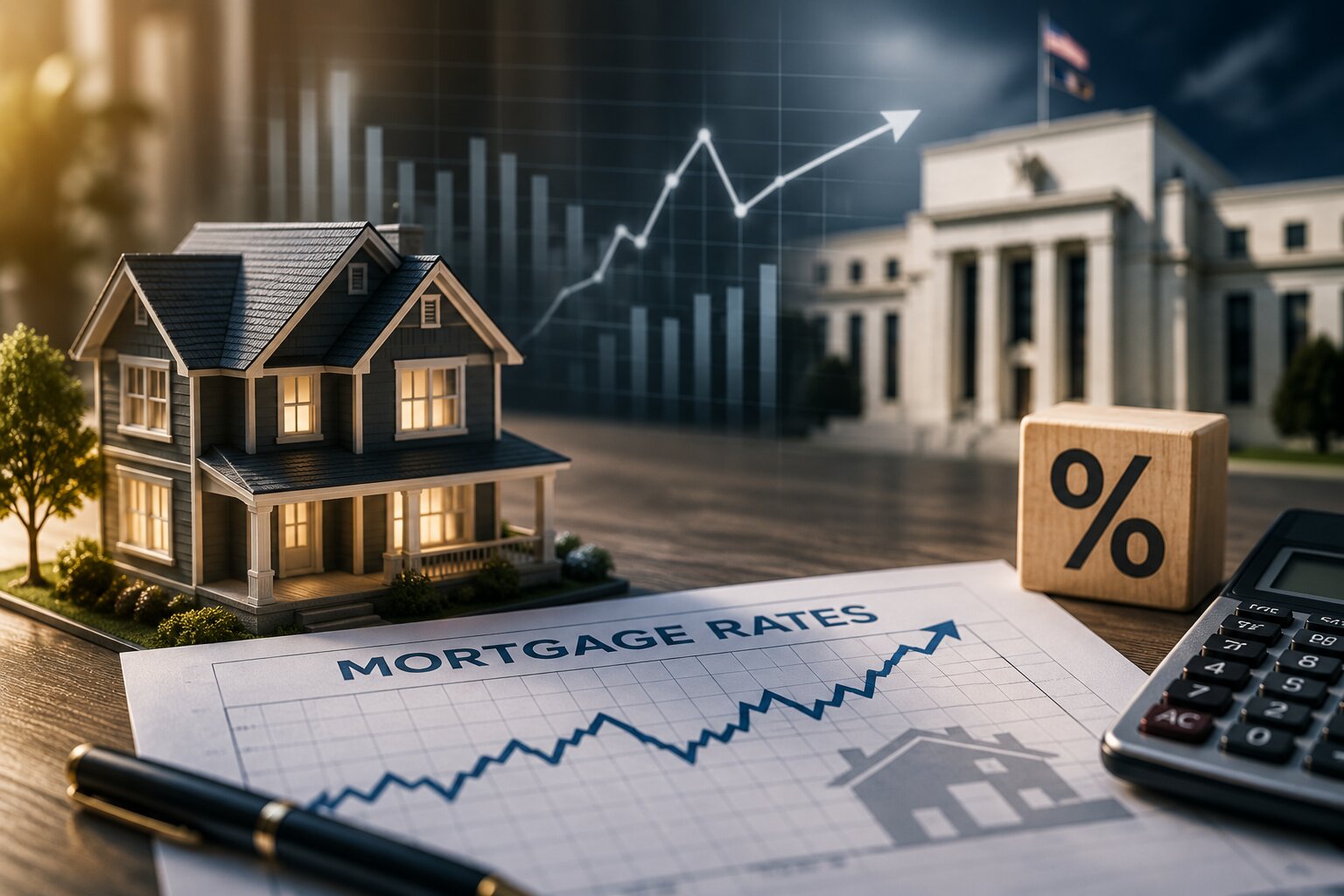
Mortgage Interest Rates After the Fed Decision: What’s Next?
 0
0
 0
0 Prospective homebuyers and homeowners seeking to refinance face a challenging economic environment. Borrowing costs surged after earlier declines, driven by geopolitical tensions, rising energy prices, and persistent inflation concerns. With the Federal Reserve holding its fifth policy meeting of the year, many consumers are watching closely to see if relief is on the horizon.
However, mortgage interest rates are unlikely to decrease after the central bank concludes its two-day session. Financial markets suggest that rates could remain elevated or even edge higher depending on the economic signals coming from monetary policymakers. Understanding these dynamics can help buyers and homeowners make informed decisions before borrowing costs shift further.
Key Takeaways
- Unlikely Rate Relief: Mortgage rates are expected to hold steady or increase following the upcoming Federal Reserve meeting, with little immediate relief expected for borrowers.
- Potential Policy Shifts: Market indicators reflect a non-zero chance of a central bank rate hike, which would immediately place upward pressure on consumer borrowing costs.
- External Market Drivers: Factors beyond central bank policy—such as 10-year Treasury yields, employment data, and energy prices—will heavily influence long-term mortgage pricing.
- Proactive Borrower Strategies: Mortgage rate locks, discount points, adjustable-rate mortgages, and thorough lender comparisons offer practical ways to manage financing costs today.
Will Mortgage Interest Rates Improve After the Fed Decision?
Borrowers hoping for a sudden drop in mortgage interest rates will likely be disappointed. Financial market tools, such as the CME FedWatch Tool, indicate that while a rate pause remains the most probable outcome, the possibility of a 25-basis-point increase cannot be completely ruled out.
Even if the Federal Reserve chooses to hold its benchmark rate steady, home loan rates could still trend upward. Mortgage lenders closely monitor the central bank’s tone during post-meeting announcements. If officials signal that future rate increases remain on the table for subsequent meetings, lenders often adjust their consumer offers upward in anticipation.
According to CBS News, market conditions suggest mortgage rates are more likely to rise or hold steady than to drop once the central bank concludes its meeting.
In addition to central bank policy, home loan pricing tracks broader financial benchmarks. The yield on the 10-year U.S. Treasury note serves as a primary driver for fixed-rate mortgages. When economic uncertainty, inflation worries, or global conflict push Treasury yields higher, mortgage borrowing costs typically follow suit regardless of immediate policy changes.
Why Securing a Mortgage Rate Lock Makes Sense
Given the likelihood of persistent or rising costs, waiting for market conditions to improve carries notable risk. Prospective borrowers actively shopping for a home or preparing to refinance should evaluate a mortgage rate lock.
[ Current Market Uncertainty ]
│
┌────────────┴────────────┐
▼ ▼
【 Rate Rises 】 【 Rate Drops 】
Protected by Rate Lock Float Down / Relock Option
A rate lock guarantees a specific interest rate for a set timeframe, usually between 30 and 60 days. This agreement protects buyers from sudden market spikes while their application processes.
- Protection Against Spikes: If broader interest rates rise before closing, the lender must honor the lower locked rate.
- Flexibility for Decreases: Many lenders offer float-down options, allowing borrowers to adjust to a lower rate if market conditions unexpectedly improve during the lock period.
Practical Ways to Secure a Lower Mortgage Interest Rate
While average benchmark rates remain elevated, borrowers can use several targeted strategies to secure lower monthly payments.
1. Purchase Mortgage Discount Points
Mortgage points allow buyers to pay an upfront fee at closing in exchange for a permanently lower interest rate. Purchasing points can significantly reduce monthly housing expenses for buyers who plan to remain in the property long-term.
2. Consider Adjustable-Rate Mortgages (ARMs)
Adjustable-rate mortgages frequently offer lower introductory interest rates compared to traditional 30-year fixed-rate loans. An ARM can provide substantial savings during the initial fixed period, making it a viable alternative for buyers who intend to move or refinance within a few years.
3. Compare Multiple Mortgage Lenders
Interest rate offers vary considerably across different lending institutions. Research from the Consumer Financial Protection Bureau emphasizes that requesting loan estimates from multiple lenders allows consumers to compare interest rates, origination fees, and closing costs to find the best deal.
Worth Exploring: Buying a home involves more than comparing mortgage rates. Which Planner is the Best for 2026? offers planning tools that can help you stay organized while budgeting for major financial goals.
Frequently Asked Questions
Will mortgage interest rates go down after the Fed meeting?
Mortgage interest rates are unlikely to drop immediately after the meeting, as market pressure and central bank policy indications lean toward steady or rising borrowing costs.
How does the Federal Reserve impact mortgage interest rates?
While the Federal Reserve does not directly set mortgage rates, its policy rate decisions and economic outlook influence the 10-year Treasury yield and overall lending costs across the banking sector.
Should I lock in my mortgage interest rate now?
Locking in your mortgage interest rate can protect you against sudden rate increases while your loan is being processed, especially during periods of economic volatility.
Related Reading: Smart financial decisions aren’t the only habits shaped by long-term thinking. Why Marginalia Is Becoming a Social Media Trend explores how intentional habits can improve learning, memory, and decision-making over time.
The Bottom Line
Mortgage interest rates are unlikely to see significant improvement following the Federal Reserve’s latest policy meeting. With economic forces favoring higher or steady borrowing costs, waiting for rates to decline presents clear financial risks. Borrowers can navigate these market conditions effectively by considering rate locks, exploring discount points or adjustable-rate options, and shopping broadly among competing lenders.
Source: CBS News. Read the original article.